
Ayahuasca Ecuador: A First-Timer’s Guide to What to Expect
A grounded introduction for people considering ayahuasca in Ecuador and their first retreat in the Amazon
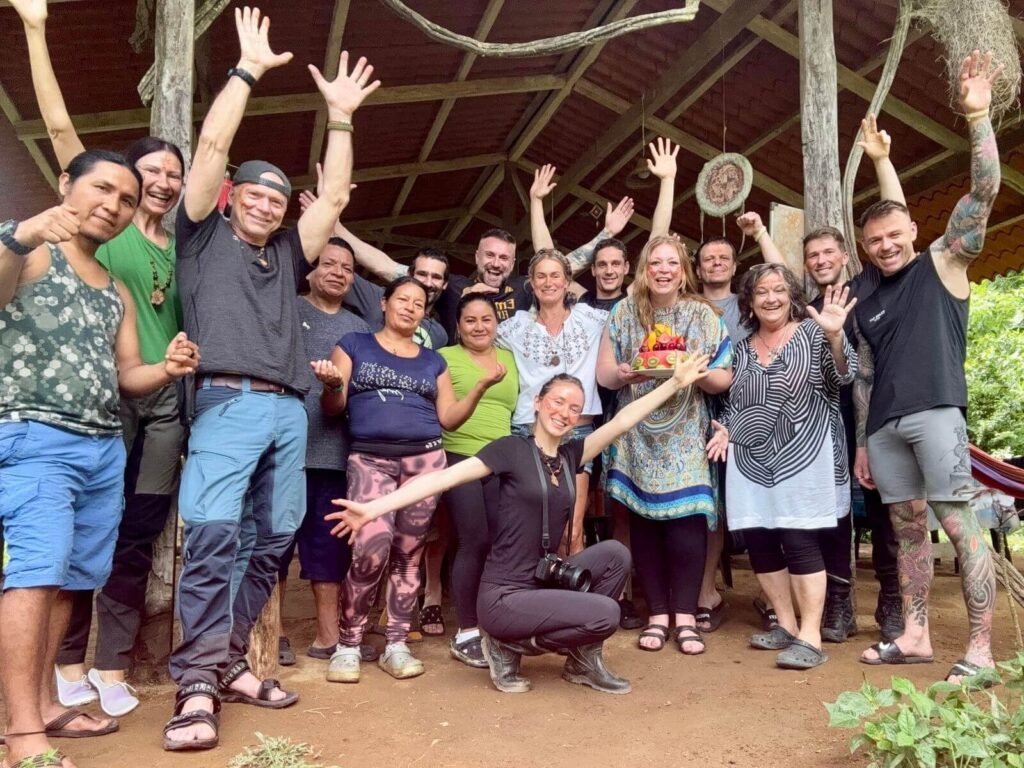
Feather Crown Ayahuasca Ecuador retreat group with the kitchen team
Approaching ayahuasca for the first time can awaken hope but it can also bring uncertainty. You may wonder whether you are ready, whether you will be safe, what a ceremony truly feels like, or how you will be supported if the experience becomes difficult.
These are important questions. Ayahuasca is a powerful traditional Amazonian medicine, not a recreational experience or a shortcut to healing. Choosing to work with it deserves time, honest reflection and careful attention to the people, tradition and environment that will hold the process.
This guide explains how we welcome first-time participants to Feather Crown Ayahuasca Retreat in Ecuador, what you can expect before, during and after the retreat, and what you should consider before deciding whether this path is right for you.
Why Experience Ayahuasca in Ecuador?
Ecuador is home to living ayahuasca traditions that continue within Indigenous communities of the Amazon. In the regions around Tena, Puyo and Pastaza, the medicine remains connected to local healers, plant knowledge, family lineages and the rainforest where these traditions developed.
Feather Crown is located near Santa Clara in Pastaza province, between Tena and Puyo. Our retreats bring first-time visitors into a small, traditional setting guided by Kichwa and Shipibo elders rather than offering ayahuasca as an isolated or tourist-oriented experience. Choosing ayahuasca in Ecuador should mean looking carefully at the healer’s experience, medical screening, ceremony support, cultural relationships and respect for the land—not simply choosing the strongest brew or the lowest price.
Ayahuasca in Ecuador, Guided by Experience and Respect
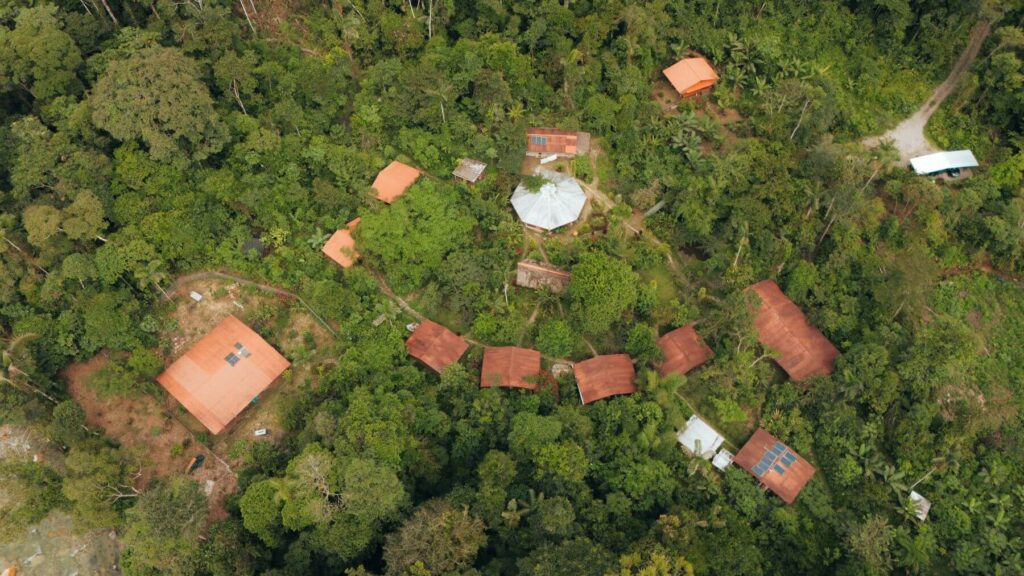
Feather Crown Ayahuasca Retreat Center in Ecuador
Feather Crown has welcomed guests to the Ecuadorian Amazon since 2008. Our retreats are guided by respected Indigenous elders from the Kichwa and Shipibo traditions and supported by a sober, attentive team throughout every ceremony.
- Small groups of no more than 12 participants, allowing for personal attention.
- Traditional ceremonies led by an elder Indigenous healer with decades of experience.
- Careful medical and psychological screening before acceptance.
- Clear preparation guidance before arrival and integration after each ceremony.
- Four to five sober helpers present during ceremonies and available until morning.
- English translation during instructions, consultations and integration conversations.
- Private or shared rooms in a dedicated healing center surrounded by protected rainforest.
- Transparent ayahuasca preparation using the vine with chalipanga or chakruna, without unknown or inappropriate admixtures.
- A gradual approach to dosing, especially for those meeting the medicine for the first time.
Our intention is not to create the strongest possible experience. It is to establish the conditions for sincere, responsible and meaningful work. No one is pressured to drink ayahuasca, to take a large dose, or to drink again during a ceremony. You may participate in the retreat and its activities without drinking if you decide not to, or if we determine that drinking would not be appropriate for your safety.
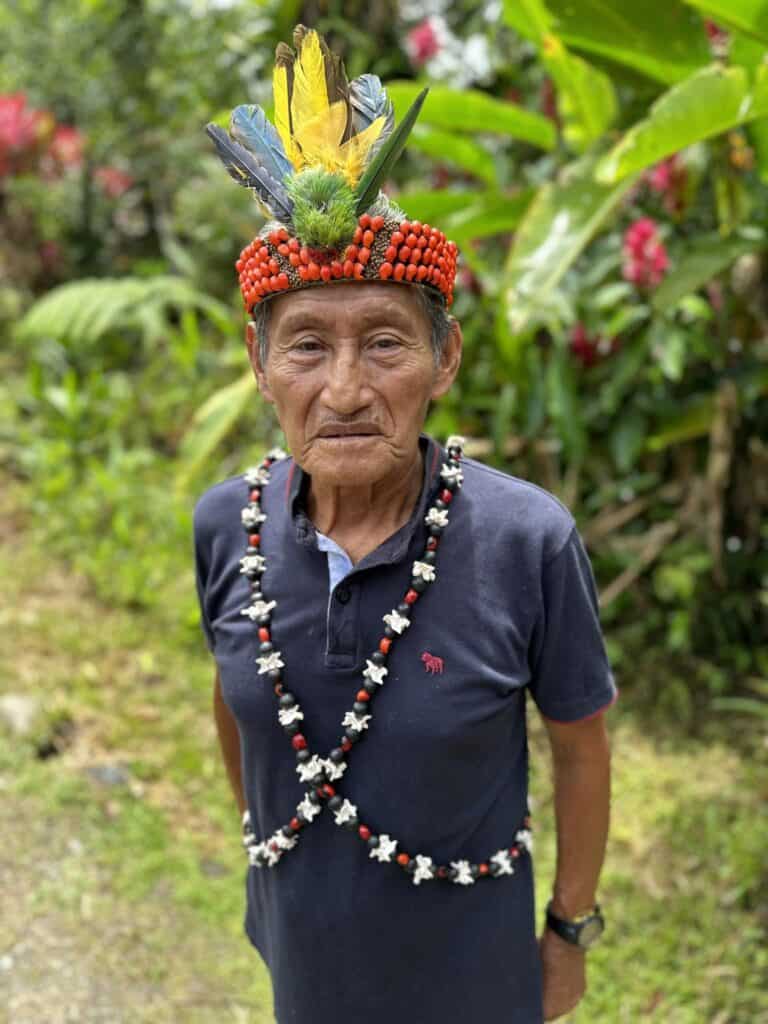
Don Carlos, Kichwa shaman leading ceremonies during Ayahuasca retreats at Feather Crown
Questions to Ask Before Your First Ayahuasca Retreat in Ecuador
A responsible decision begins before you choose a date or book a flight. We encourage you to consider three areas carefully.
Safety and trust
- Does the center ask detailed questions about health, medication and psychological history?
- Who leads the ceremonies, and how many years or decades of traditional experience do they have?
- Are sober assistants present for the entire night?
- Will someone help you walk to the bathroom or remain with you during an intense moment?
- Does the center explain exactly what is in the ayahuasca?
- Are personal boundaries, privacy and dignity clearly protected?
- Is there an emergency plan and access to outside medical care?
Your intention and readiness
- Why are you considering ayahuasca at this point in your life?
- Are you seeking healing and sincere inner work, or mainly an unusual experience?
- Are you willing to follow the health, medication, diet and behavioral guidelines?
- Can you approach an Indigenous tradition with humility, without demanding a particular vision or result?
- Are you willing to take responsibility for integration after returning home?
Time and practical preparation
- Can you leave enough space before and after the retreat to arrive rested and return gradually?
- Can you avoid rushing directly from the retreat into heavy work, conflict or major decisions?
- Can you arrange international travel so that you arrive in Quito at least one day before the retreat begins?
- Do you have trusted support at home if difficult emotions continue to unfold afterward?
How Do I Know Whether I Am Ready?
There is rarely a moment when every doubt disappears. Readiness does not necessarily feel like complete confidence. It may include respect, nervousness and an honest awareness that you are approaching something greater than an ordinary experience.
Qualities that support this work include:
- A sincere intention, without demanding a guaranteed outcome.
- Medical and psychological eligibility.
- Willingness to communicate openly about your health and history.
- Respect for the medicine, the healer, the group and the Indigenous tradition.
- Patience with a process that may unfold gradually rather than in one dramatic ceremony.
- Willingness to meet fear with attention instead of hiding it or trying to overpower it with a larger dose.
- Acceptance that ayahuasca does not promise a cure and that you remain responsible for your healing choices.
You do not need a perfectly formulated intention. A simple and honest question may be enough: What in my life is asking to be seen, understood or changed?
Safety Begins Before You Arrive
Safety is not an additional feature of an ayahuasca retreat. It is the foundation that allows trust and deeper work to become possible.
Health and medication screening
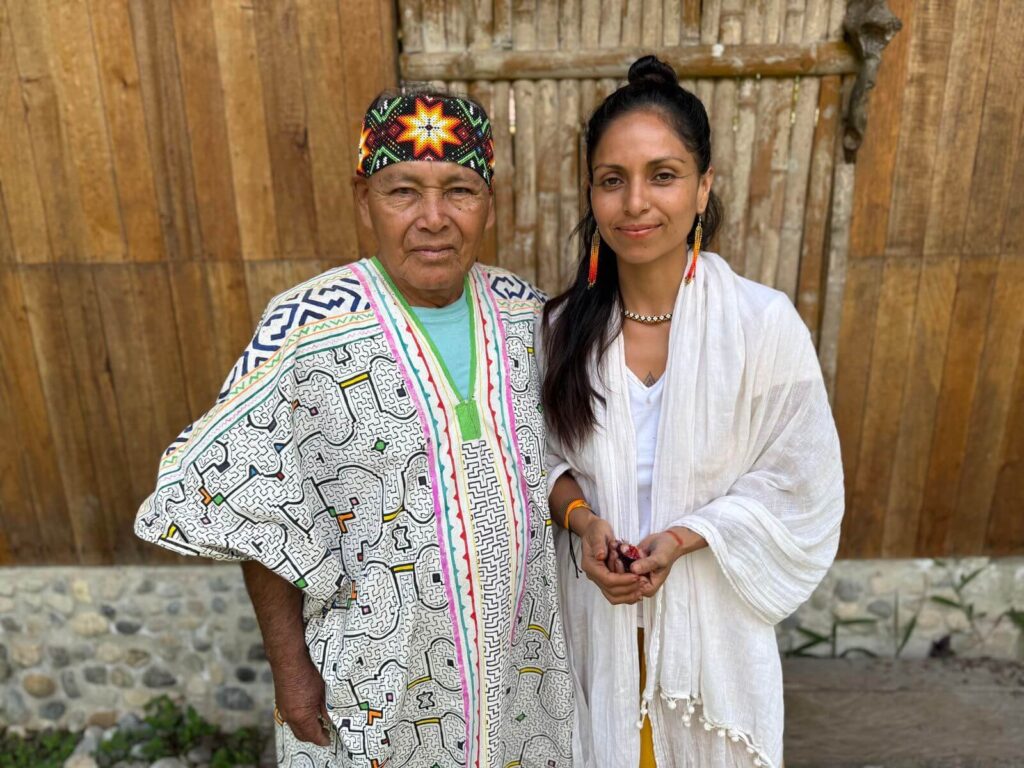
Shipibo healer Maestro Sina with an Ayahuasca retreat assistant
Every applicant must disclose all medical conditions, psychiatric history, medications, supplements, natural remedies and recent substance use during registration. We review each application individually and may ask follow-up questions, request medical information or arrange a video conversation.
Ayahuasca can interact dangerously with certain medications and is not suitable for everyone. Serious heart conditions, uncontrolled high blood pressure, epilepsy, psychosis, schizophrenia, mania, some forms of bipolar disorder, active suicidal thinking, severe addiction and other significant conditions may prevent a person from drinking ayahuasca or attending the retreat.
Feather Crown follows a strict policy concerning medications and supplements. Everything used within the relevant preparation period must be disclosed, and any exception requires written approval. Some medications are incompatible with ayahuasca. When reducing or discontinuing a particular medication sufficiently in advance is necessary for safe participation, this is a condition of participation rather than a treatment instruction. You decide for yourself whether to change your medication and meet that condition. Before changing prescribed medication, we recommend first obtaining information from the qualified clinician who prescribed it about the risks and a safe way to reduce or discontinue it. Then tell us what you actually changed and when you took the last dose so that we can assess the required interval and your eligibility to participate. In some cases, continuing essential treatment means that ayahuasca is not an appropriate option.
Pregnant participants may not ingest ayahuasca or other plant medicines and must inform us immediately. Please read our complete health, medication and safety requirements before applying.
Experienced Indigenous leadership
Depending on the retreat date, ceremonies are led by Don Carlos Landázuri or Maestro Sina.
Don Carlos is an 81-year-old Kichwa yachak from the Napo region of Ecuador. His work includes traditional songs accompanied with surupanga leaf fan, energetic diagnosis and individual limpias (cleansings) adapted to each participant.
Maestro Sina is a 73-year-old Shipibo elder from Ucayali, Peru, from a lineage of onanyas. He has served his community and international guests for more than 40 years. His ceremonies center on icaros, individual energetic work and the plant knowledge transmitted through his family lineage. He is always accompanied on selected retreats by one of his sons, who have trained for many years to continue this tradition.
Jan Rostlinka, the retreat organizer, with Don Carlos, Kichwa Shaman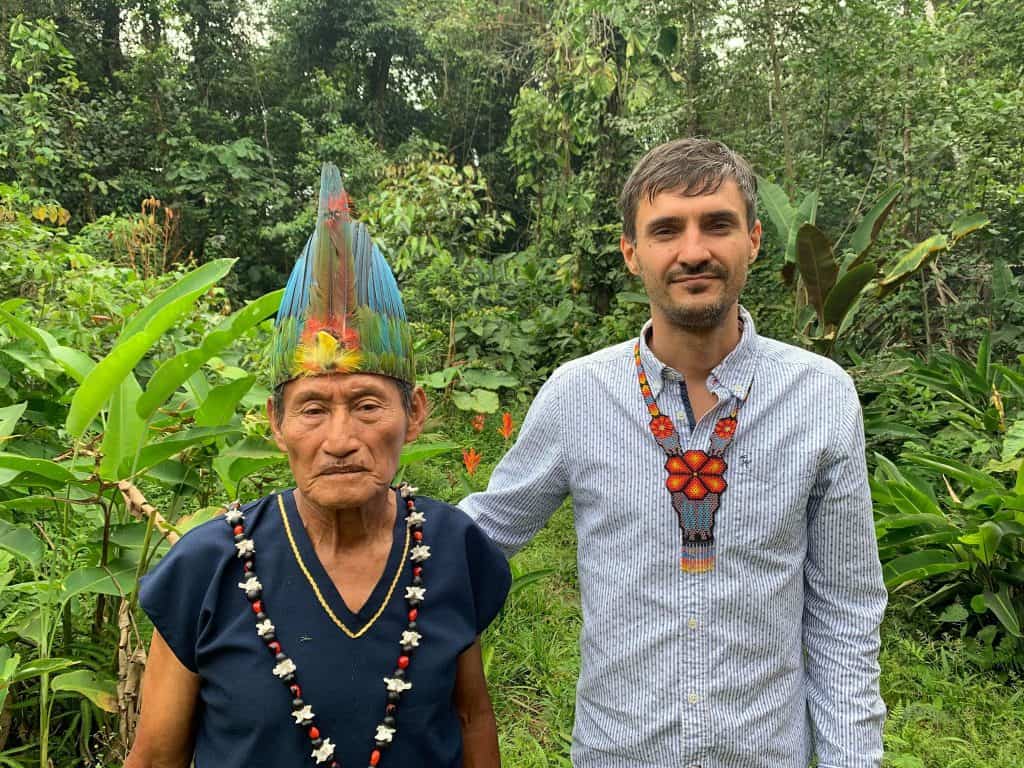
Jan Rostlinka, 44 years old from Czech republic, founded Feather Crown after moving to the Ecuadorian Amazon in 2008. He organizes the retreats, translates between guests and Indigenous healers, supports participants throughout their process, and helps create a respectful bridge between cultures. His learning has developed through long-term relationships with Kichwa, Shipibo and Yawanawá teachers, and he remains deeply respectful of the Indigenous elders who guide the principal healing work. After more than 13 years of apprenticeship with Maestro Sina, Jan is recognized by him as a maestro and is expected to offer songs and assistance during ceremonies. His role is not to replace his teachers, but to contribute responsibly to the healing work in accordance with their guidance and trust.
Sober ceremony support
At least four helpers remain sober and attentive throughout the night. They assist participants who need water, reassurance, a blanket, help changing position, or accompaniment to the bathroom. At least one team member remains awake and available until morning.
Before the first ceremony, we have an explanatory session with questions and answers where we explain how to ask for help, how to move safely, where the toilets are, how personal space is protected, and what to do if the effects feel overwhelming. Toilets are located only a few meters from the ceremonial temple.
Emergency readiness
Feather Crown is a retreat center, not a hospital or Western medical facility. This is why careful screening and full disclosure are essential. We maintain a crisis protocol and transport access to outside medical care; a local medical post is approximately 15 minutes away (vehicle and sober driver always available) and a hospital approximately 40 minutes away. These arrangements do not make an unsuitable medical condition safe for ayahuasca.
Fear Is Normal—And It Deserves to Be Heard
Many first-time participants worry about losing control, becoming overwhelmed, vomiting, fainting, seeing frightening images, reopening trauma, or not returning to normal. Others fear the opposite: that nothing will happen and they will have failed.
Fear is not always a sign that you should proceed, and it is not always a sign that you should turn away. Sometimes it points to a real safety question that needs an honest answer. Sometimes it reflects the vulnerability of approaching an unknown inner process. The important thing is not to hide it.
At Feather Crown, first-time participants begin with an introductory amount rather than being pushed toward a powerful dose. We observe how each person responds. You can ask to proceed slowly, decline another serving, or decide not to drink. If confusion or panic arises, a helper can stay near you, help you orient to the room and guide your attention back to the healer’s song.
An unpleasant passage does not automatically mean that something has gone wrong. At the same time, no one is expected to suffer silently. You may ask for support at any point.
Our detailed article Ayahuasca and Fear explores the most common concerns and explains how we respond to them during our retreats.
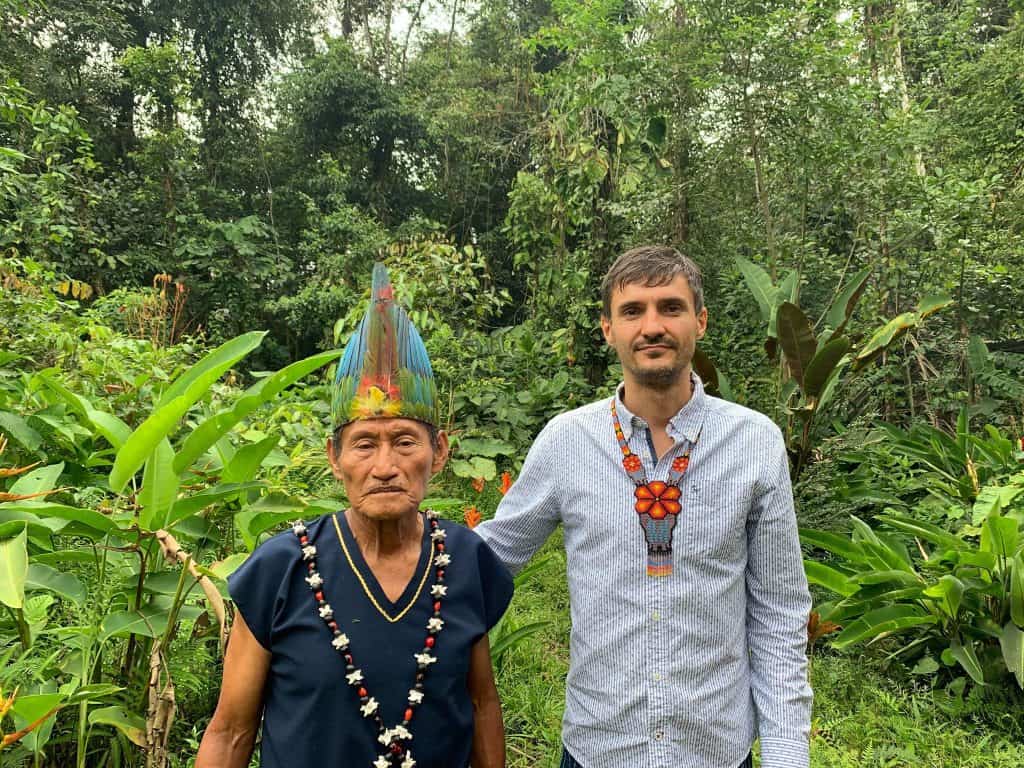
Don Carlos, the Kichwa shaman leading ceremonies, with Jan Rostlinka, Ayahuasca Ecuador organizer
What Happens During an Ayahuasca Ceremony?
Ceremonies take place at night in our spacious circular temple, surrounded by the sounds of the rainforest. Each participant has an assigned place to rest and remain focused on their own process.
- Preparation and orientation: Before the ceremony, we review safety, movement, communication and what to expect. A traditional flower bath helps prepare and settle the body and energy.
- Serving the medicine: Drinking is voluntary. First-time participants receive an introductory amount. Any additional serving is considered carefully according to timing, sensitivity, experience and current condition.
- Traditional healing work: The healer guides the ceremonial space through icaros or traditional songs, prayer, instruments and individual cleansings. These songs are not entertainment; within the tradition, they orient and support the healing work.
- Practical care: Sober assistants remain present to help with movement, blankets, water, purging, reassurance and bathroom visits.
- Rest until morning: Support remains available after the main ceremonial work ends. Participants are not left alone while still strongly affected.
- Integration: After rest, participants can share what arose, ask the healer questions through translation and receive guidance for the next stage of the process.
Ayahuasca may bring visions, emotions, memories, bodily sensations, silence, discomfort or profound peace. A ceremony without vivid visions is not necessarily an unsuccessful ceremony. Important work may be subtle and may only become clear over the following days or weeks.
Purging, Nausea and Using the Bathroom
Nausea and vomiting are common concerns. In Amazonian traditions, purging may be understood as part of cleansing, but it is never treated as a performance or a requirement. Some people vomit and others do not.
Each participant has a container nearby, and the team helps discreetly when needed. Repeated vomiting, unusual weakness, faintness or any concerning symptom receives closer attention. We do not recommend extreme fasting for the entire day, because dehydration and weakness can increase the risk of dizziness. Follow the specific meal and hydration instructions provided before your retreat.
If you need the bathroom, call a helper. The toilets are adjacent to the temple, and someone can accompany you so that you do not have to walk alone while strongly affected.
Respecting Boundaries and Protecting Dignity
During an altered state, a participant may feel unusually vulnerable. Ethical conduct and clear boundaries are therefore essential.
Our team treats crying, trembling, vomiting, needing help or expressing emotion as human parts of the process—not as something shameful. Support is offered calmly and without judgment. Touch must be appropriate, non-sexual and connected to a clear practical or traditional purpose. Participants are told who they can speak to if any interaction feels uncomfortable.
What happens during ceremony is treated with discretion. We do not use a person’s vulnerable moments as entertainment or share them without consent.
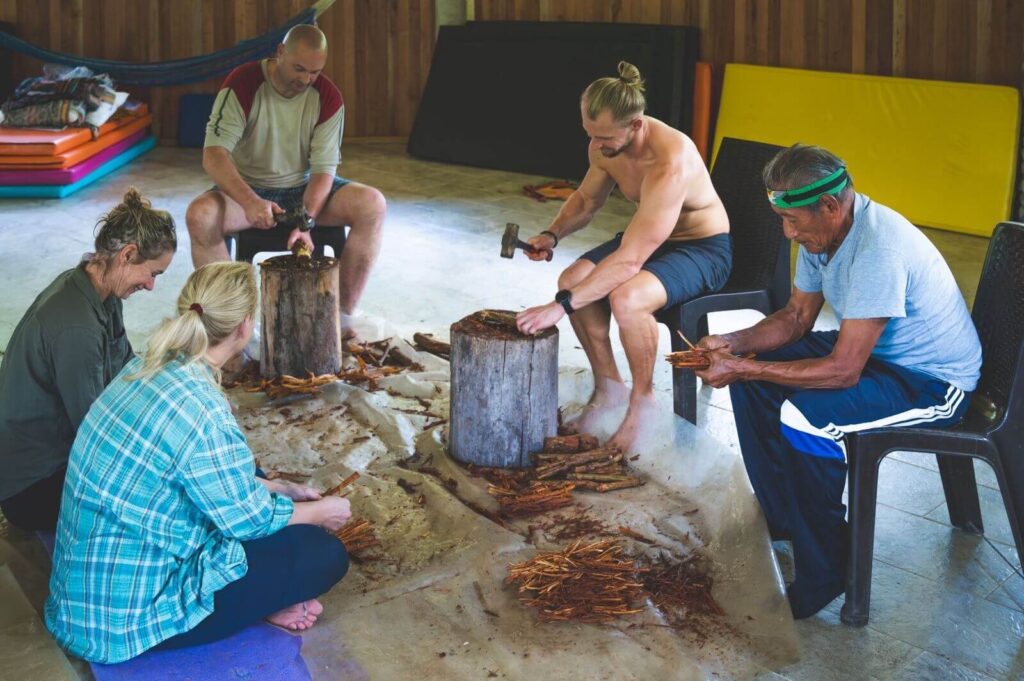
Retreat participants preparing ayahuasca with Kichwa healer Don Carlos
What Is in the Ayahuasca?
Our medicine is prepared traditionally over a fire from Banisteriopsis caapi vine and either Diplopterys cabrerana, known locally as chalipanga, or Psychotria viridis, known as chakruna. We do not use toé, synthetic substances or undisclosed admixtures.
The vines cultivated at Feather Crown include lineages inherited from resident shamans and varieties gathered from different parts of Ecuador and the wider Amazon. During the retreat, guests may take part in harvesting and preparing the medicine, allowing them to see the plants and understand the process directly.
Learn more about our regenerative ayahuasca cultivation and our commitment to preserving strong, healthy vines for future generations.
Preparing Your Body and Mind
Preparation is more than a list of restrictions. It is a gradual movement away from daily noise and toward greater attention.
Follow the health and dieta instructions
All medications, supplements and natural remedies must be disclosed. Alcohol and sexual activity must be avoided for at least three days before the retreat, and cannabis and other psychoactive substances for at least one week. Some medications require a much longer discontinuation period before ayahuasca. When discontinuation is required for safe participation, we state this as a participation condition; you decide whether to make that change and attend. Because changing prescribed treatment can itself carry risks, we recommend first obtaining information from the prescribing clinician about the underlying condition and a safe way to make the change. If you decide to discontinue medication for the retreat, inform us what you changed and when you took the last dose so that we can assess the required interval and eligibility. The instructions sent after screening are authoritative for the retreat requirements in your individual case.
Slow down
If possible, reduce unnecessary stimulation in the days before travel. Rest, spend time in nature, meditate, write or simply leave more quiet space in your schedule. You do not need to force yourself into an ideal spiritual state.
Set an intention without creating a demand
An intention offers direction; an expectation tries to control the result. Reflect on what you hope to understand or heal, while remaining open to a process that may unfold differently from what you imagined.
Organize your return
Whenever possible, avoid arranging stressful commitments immediately after the retreat. Give yourself time to sleep, eat well, reflect and allow the experience to settle.
Choosing Between a 5-Day and 10-Day Retreat
5-day retreat
The 5-day program includes two ayahuasca ceremonies, two individual cleansings, plant baths and integration after each ceremony. It is always one half of the complete 10-day itinerary, so the exact rainforest and cultural activities depend on whether you join the first or second five-day segment.
10-day retreat
The 10-day program is the complete Feather Crown retreat: four ceremonies instead of two, four integration sessions, and the full activity sequence across both five-day segments. The current itinerary includes the broader rainforest and cultural program, with activities such as ayahuasca preparation, jungle excursions and a night walk, Indigenous cultural activities, medicinal-plant learning and the waterfall and petroglyph excursion.
If you are medically eligible and have the time, we generally consider the 10-day format the more complete first retreat because it provides all four ceremonies and the full program. The 5-day retreat remains a valid option for people who need or prefer one half of the itinerary.
Compare Feather Crown’s ayahuasca retreats in Ecuador, including the 5-day and 10-day formats, or ask us which format may suit you.
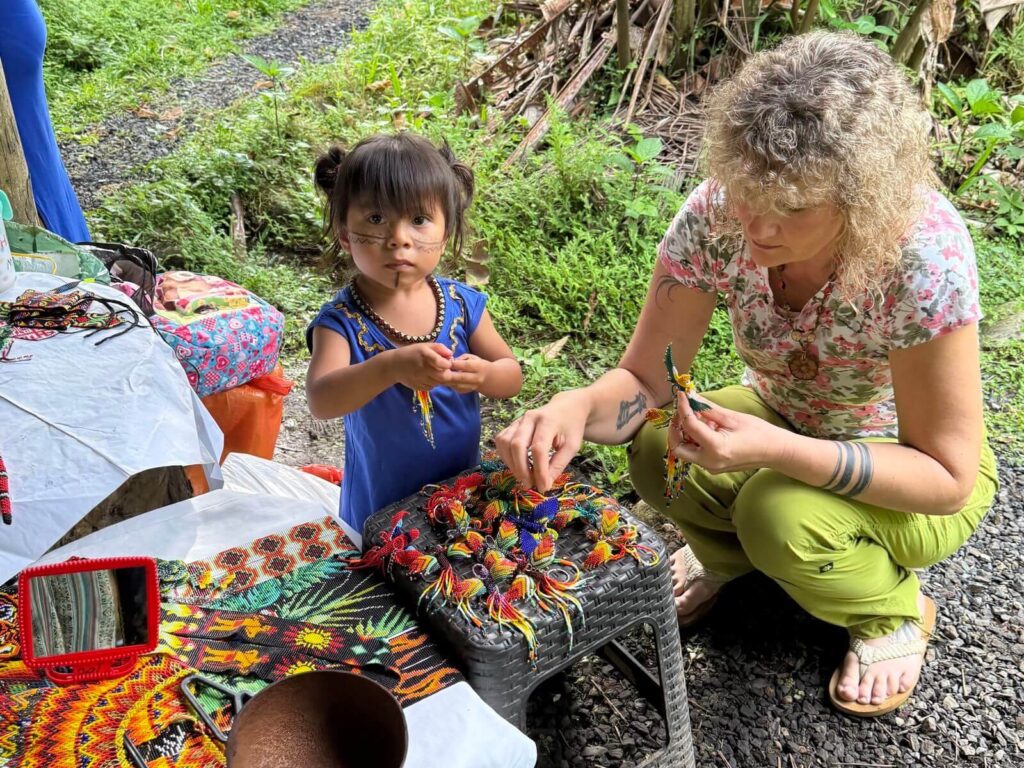
A meeting between Amazonian Kichwa and European cultures at Feather Crown
Life at Feather Crown
Our center lies near Santa Clara in Pastaza, where the Andes descend into the Amazon. It is approximately four hours from Quito and about one hour from Tena and Puyo.
The property covers 23 hectares of private rainforest reserve beside the clear Piatúa River. It borders protected forest connected with a university biological reserve and Llanganates National Park. There is no city noise or nightlife—only the river, rain, insects, birds and the changing rhythm of the forest.
Guests stay in simple, clean bamboo cabins with private rooms for one person, a couple, or a family. Guests are never placed in rooms with strangers. Beds have orthopedic mattresses, thermal blankets and personal mosquito nets. The center has hot showers, toilets cleaned daily, solar electricity, lighting and sockets, and high-speed Wi-Fi in the accommodation area. The purpose is not luxury, but enough comfort and privacy to rest well and focus on the process.
Meals are nourishing and adapted to ceremonial work, with vegetarian and vegan options. Depending on the program, meals may also include fish or organic chicken. Please tell us about genuine dietary needs before arrival; do not bring outside foods or supplements without approval.
Explore the Feather Crown retreat center and accommodation.
Traveling to Ecuador for an Ayahuasca Retreat
Most international visitors fly to Quito’s Mariscal Sucre International Airport. Plan to arrive in Quito at least one day before the retreat begins. This protects you against flight delays and gives your body time to rest before traveling into the Amazon.
The drive from Quito or the airport to Feather Crown takes approximately four hours. We can help arrange reliable private or group transportation. Public buses and shared taxis are also possible, but most first-time international guests find organized transport simpler.
Bring light long-sleeved clothing, rain protection, comfortable clothes for ceremony, a flashlight or headlamp, sandals and secure walking shoes. Mosquito nets are provided, and rubber boots can be borrowed. Avoid strongly perfumed toiletries and chemical repellents; ask us which products are suitable at the center.
See our travel information for Santa Clara before booking your route.
Integration: Bringing the Experience Home
A retreat may open a door, but it does not walk the path for you. Insights become valuable when they are translated into patient, grounded changes in daily life.
- Give yourself time to rest after returning home.
- Avoid making irreversible decisions during the first emotional wave.
- Write down what you remember without forcing an immediate interpretation.
- Continue simple practices that support stability: sleep, nourishing food, nature, movement, meditation or creative work.
- Seek qualified therapeutic support if trauma, instability or difficult symptoms continue.
- Stay in contact with us when you need clarification about the retreat process.
Integration does not mean holding on to a peak experience. It means allowing what was learned to become visible in relationships, choices, habits and the way you care for yourself and others.
Reciprocity: Receiving From the Amazon and Giving Back
Coming to the Amazon for healing creates a responsibility toward the land and the people whose knowledge makes this work possible.
Feather Crown provides stable employment for local Kichwa families, pays Indigenous healers and team members fairly, contributes additional support to family-led tourism and construction projects, and offers space for Indigenous cultural gatherings and documentary work.
We cooperate with PONAKICSC (Pueblo Originario Kichwa del Cantón Santa Clara), an organization representing 22 communities. We also participate in the defense of Kichwa territory and the sacred Piatúa River against destructive hydroelectric and mining pressures.
Learn more about reciprocity toward the Amazon and its Indigenous people.
How the Booking Process Works
- Explore the programs: Compare the 5-day and 10-day retreats, the dates and the Indigenous elder leading each program.
- Read the safety requirements: Review contraindications, medication rules and preparation obligations before making travel plans.
- Complete the application: Provide complete health, psychological and medication information. Omissions can put you and the group at risk.
- Respond to follow-up questions: We may request additional information, a doctor’s opinion or a video call before deciding whether participation is appropriate.
- Receive approval and confirm your place: Once accepted, follow the payment instructions to secure your reservation.
- Prepare and arrange travel: Follow the individual guidelines you receive and plan to arrive in Quito at least one day before the retreat.
A thorough application is not an obstacle placed between you and the retreat. It is one of the clearest signs that the process is being approached responsibly.
Frequently Asked Questions for First-Time Participants
Why do people choose ayahuasca in Ecuador?
Ecuador offers direct access to living Amazonian traditions, Indigenous healers and rainforest regions where ayahuasca remains part of local cultural knowledge. The country alone does not guarantee a responsible retreat, so visitors should still examine the healer’s experience, screening, group size, support and ethical relationships.
Where is Feather Crown located in Ecuador?
Feather Crown is near Santa Clara in Pastaza province, in the Ecuadorian Amazon between Tena and Puyo. The center is approximately four hours by road from Quito and its international airport.
Is ayahuasca safe for a first-time participant?
Ayahuasca can be approached more safely when medical and psychological screening is thorough, contraindicated medications and conditions are excluded, the brew is transparent, an experienced traditional healer leads the ceremony, and sober support remains present. Risk can never be reduced to zero, and ayahuasca is not suitable for everyone.
Do I have to drink ayahuasca at every ceremony?
No. Drinking is voluntary. You may decline a serving, stop after an introductory amount, attend a ceremony without drinking, or be asked not to drink if the team believes it is unsafe or inappropriate.
What if I am afraid of losing control?
This fear is common. We begin gradually, explain how to orient yourself, and keep sober helpers close. You can ask for support at any time and are never pressured to take a stronger dose.
What if I do not see visions?
Visions are not the measure of a successful ceremony. Ayahuasca may work through emotion, bodily awareness, memories, quiet reflection or changes that become clearer later. We do not encourage unnecessary additional doses merely to produce visual effects.
Will I vomit?
You may, but not everyone does. Containers are provided and the team helps discreetly. Vomiting is not considered shameful or a failure. Persistent or unusually exhausting symptoms are monitored closely.
Can I take my regular medication or supplements?
Do not assume that any medication, supplement or natural remedy is compatible. Everything must be disclosed. Feather Crown follows a strict no-medication and no-supplement policy unless a written exception is granted. If discontinuing prescribed treatment is necessary to meet the conditions for safe participation, you decide whether to make that change and attend. Before changing prescribed medication, we recommend first obtaining information from the clinician who prescribed it about the risks and a safe way to discontinue it. If you decide to make the change, tell us what you changed and when you took the last dose so that we can assess the required interval and eligibility.
What exactly is in your ayahuasca?
It is prepared from Banisteriopsis caapi vine and either chalipanga or chakruna. We do not use toé, synthetic substances or undisclosed admixtures. Guests may observe and participate in the traditional preparation process.
Is a 5-day retreat enough for a beginner?
It can provide a meaningful introduction and includes two ceremonies, but it covers only one half of the complete activity itinerary. The 10-day retreat offers four ceremonies and the full Feather Crown program across both five-day segments, and is generally the more complete option when time and eligibility allow.
Will I understand the healer if I do not speak Spanish?
Yes. Important instructions, consultations and integration conversations are translated into English. The healer’s icaros or traditional songs are received in their original ceremonial form.
Will I have a private room?
Private and shared arrangements are available in bamboo cabins. Rooms include orthopedic mattresses, blankets, mosquito nets, electricity and jungle views. Confirm your preferred arrangement when booking.
Is there Wi-Fi?
Yes. High-speed Wi-Fi is available in the accommodation area. We nevertheless encourage guests to reduce unnecessary phone use so they can remain present with the retreat and the forest.
Can ayahuasca cure my illness or trauma?
We do not guarantee cures. Ayahuasca may support insight, emotional processing and meaningful change, but outcomes vary. Feather Crown is not a medical clinic, and the retreat does not replace medical or psychological treatment.
Considering Ayahuasca in Ecuador? We Are Here to Help
You do not have to arrive without fear, and you do not have to pretend to be certain. What matters is that you approach the decision honestly, disclose your health fully and choose a setting whose experience and ethics you can verify.
Feather Crown is a small, traditional healing center rather than a tourist resort. We welcome people who feel a sincere call to work with ayahuasca and who are prepared to meet the process with respect, patience and responsibility.
Request a conversation with us or review the current retreat dates and programs.
REQUEST A CALL
If you prefer WhatsApp, contact Feather Crown at +593 999 608 184.
